The 7 Best MIDI Controllers With Weighted Keys (2026)
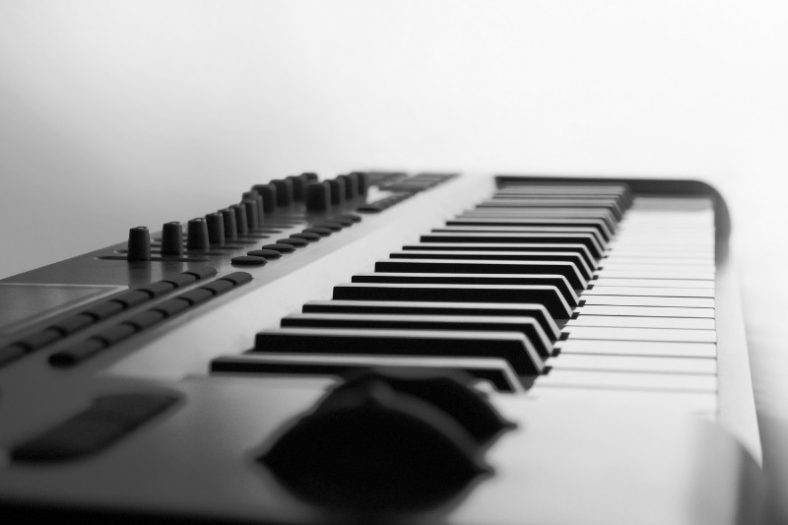
MIDI keyboards are essential parts of a music studio for producing any type of music. As most piano players want the feel of an analog piano on a workstation of music production, the key weight and type are vital for a good MIDI keyboard.
MIDI keyboards with weighted keys offer next-level playability and an authentic piano feel for dynamic performances. Depending on what key size you prefer, the market is stacked with suitable MIDI keyboards with weighted keys, however, the list below features five hammer-action controllers, one digital piano and one semi-weighted sequencing exception. The 61SL MkIII is useful for synth and CV work, but it does not feel like a weighted piano.
My top MIDI controller with weighted keys is the M-Audio Hammer 88, a great full-size keyboard with hammer-action keys that allow limitless expression.
If an 88-key board will not fit, consider the Studiologic SL73 MK2 for a shorter hammer-action keyboard.
Contents
- The 7 Best MIDI Controllers With Weighted Keys (2026)
- 1. M-Audio Hammer 88
- 2. Studiologic SL73 MK2
- 3. Native Instruments Kontrol S88 MK3
- 4. Roland FP-10
- 5. Novation 61SL MkIII
- 6. Arturia KeyLab 88 mk3 White
- 7. M-Audio Hammer 88 Pro
- What are the different types of weighted keys?
- Are weighted keys harder or easier to handle?
- What are the benefits of weighted keys on a MIDI controller?
- What is the optimal number of keys to aim for?
- What to look for in a MIDI controller with Weighted Keys?
- Conclusion
The 7 Best MIDI Controllers With Weighted Keys (2026)


Let’s compare these in more detail.
1. M-Audio Hammer 88
The M-Audio Hammer 88 is one of the most realistic feeling keyboard controllers today with its full-size keyboard with 88 fully-weighted, velocity-sensitive hammer action keys. The controller is fully focused on the feel and expression of an authentic piano, without the extra frills of other MIDI controllers.
Pros
- Full-size keyboard with great-feeling hammer action keys
- Editor app for MIDI functions customization
- A good amount of pedal input ports
- Included software bundle
Cons
- Keys do not have aftertouch
Besides the great-feeling keyboard, the Hammer 88 has inputs for sustain, expression, and soft pedals. The pitch bend and modulation wheels, along with volume and octave controls, are located on the left-hand side of the keys, which is more comfortable to use than the ones in the top position, in my opinion.
The controller comes with Ableton Live Lite and Hammer 88 software editor, which you can use to customize features such as keyboard zones and velocity curves.
The drawbacks are the keys’ lack of aftertouch and the overall weight of the unit. As it is a full-size keyboard with weighted keys, it is a heavy MIDI keyboard, making it less portable.
| Weight Type | Fully-Weighted |
| Key Type | Hammer-action velocity-sensitive keys |
| Number Of Keys | 88 |
| Controls | Pitchbend, modulation, volume, and octave controls |
| Compatibility | OS X 10.8 or newer, iOS, Windows 7 SP1 or newer |
| Included Software | Ableton Live Lite, Hammer 88 software editor |
If playing synths and organs or making grooves with pads is your primary goal Hammer 88 is not for you. However, the M-Audio Hammer 88 is an ideal choice for piano players who want a full-size MIDI keyboard that feels as close to a piano as possible.

2. Studiologic SL73 MK2
The Studiologic SL73 MK2 is the compact hammer-action pick for a pianist who cannot fit another full-width 88-key board. Its 73-key TP/110 action gives a weighted piano-style response in less space than a full 88-key board.
This is a controller rather than a self-contained piano. Its focus is playing feel and MIDI control; add a computer, sound module or software instrument to hear it. The shorter key range is the reason to choose it, not a claim that it matches the span of the Hammer 88.
Players who need pads and extensive mixing controls should look at the Hammer 88 Pro below. This SL73 keeps the emphasis on a playable hammer-action keybed.
Pros
- 73-key hammer action saves space
- Piano-focused playing feel
- Works with software or external MIDI instruments
Cons
- Shorter range than 88-key options
- Requires an external sound source
Specifications: 73 weighted hammer-action keys; MIDI controller; USB connectivity.
3. Native Instruments Kontrol S88 MK3
The Kontrol S88 MK3 is the premium software-instrument choice for a pianist invested in Native Instruments and NKS libraries. Its 88-key weighted Fatar action gives the playing span this guide promises, while the display and controls keep sound browsing close to the keyboard.
Polyphonic aftertouch lets compatible software respond to pressure on individual held notes. Its display, light guide and NKS browsing are most valuable if your virtual instruments already live in that ecosystem.
Choose it for deep NKS workflow rather than maximum generic DAW controls. The Arturia KeyLab 88 mk3 below is the broader hands-on mapping alternative. It is a substantial keyboard that needs desk or stand space; check local stock for the exact S88 MK3 before ordering.
Pros
- 88 weighted keys
- Integrated NKS browsing and controls
- Polyphonic aftertouch
Cons
- Large footprint
- Premium size and weight
Specifications: 88 weighted Fatar keys; color display; NKS integration; USB MIDI.
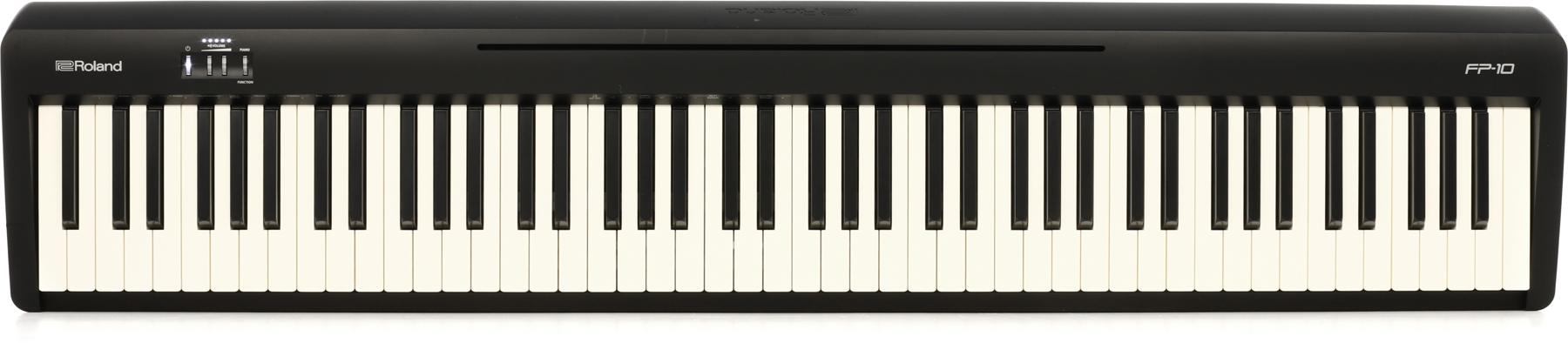
4. Roland FP-10
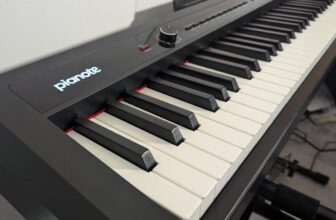
The Roland FP-10 is the self-contained piano choice on this list. Its 88-key PHA-4 hammer action, built-in piano sounds and speakers make sense for practice without opening a DAW. It can also send MIDI to a computer or compatible device when you want software instruments.
It is a digital piano first, not a controller covered in pads and faders. That distinction matters: buy the Hammer 88 or KeyLab if your main task is controlling a production session. Choose the FP-10 when standalone piano practice and a weighted playing feel are the priorities.
The FP-10 needs a stand or suitable surface and takes more space than a compact controller. Its internal sounds are a practical advantage for anyone alternating between piano study and home recording.
Pros
- PHA-4 weighted hammer action
- Built-in sound and speakers
- MIDI for software instruments
Cons
- Few DAW controls
- Full-size piano footprint
Specifications: 88 PHA-4 hammer-action keys; built-in speakers; USB/Bluetooth MIDI.
5. Novation 61SL MkIII
The Novation 61SL MkIII is a great MIDI keyboard with 61 full-size semi-weighted synth keys with velocity sensitivity and aftertouch. Plus, it has 16 velocity-sensitive RGB pads, 8 encoders, 8 faders, pitch bend, and mod wheels with RGB light, adding to the versatility.
Pros
- Premium quality keyboard
- Excellent 8-track sequencer
- A great number of connectivity options
- Versatile with a good range of controls
- Great features arpeggiator, scales, keyboard zoning, and DAW control mode
Cons
- A bit pricey
- Semi-weighted keys
- No fader displays
- Not the best navigation
The shining stars of this device are the excellent 8-track sequencer, arpeggiator, scales, keyboard zoning, and DAW control mode, making the device highly versatile. There is also the SL49 model with 49 keys, which is a portable and affordable option from Novation for musicians.
The great number of connectivity options including a 1/4″ (expression), a 1/4″ (sustain), 1a 1/4″ (footswitch) pedal inputs, a clock out, two CV outs, two mod outs, two gate outs, MIDI in and out, Out2/Thru and USB ports.
| Weight Type | Semi-weighted |
| Key Type | Full-size synth keys with velocity sensitivity and aftertouch |
| Number Of Keys | 61 |
| Controls | 16 velocity-sensitive RGB pads, 8 Encoders, 8 Faders, pitch bend, a mod wheel with RGB |
| Compatibility | Windows 7 SP1 or later, OS X 10.11.6 or later |
| Included Software | Ableton Live Lite, 4GB Loopmaster Sounds and Samples |
There is not much to say against the Novation 61SL MkIII besides that it is a bit pricey. Piano players may not like the semi-weighted synth-action keys as the fully-weighted keys replicate the authentic feel better. If you have the budget for it, the Novation 61SL MkIII is a top-notch 61-key MIDI controller for music production and live performances with excellent versatility.

6. Arturia KeyLab 88 mk3 White
The Arturia KeyLab 88 mk3 is the full-size production workstation pick. Its Fatar TP/110 weighted hammer action makes piano parts credible, while pads, faders, encoders and screen give much more direct DAW and instrument control than the basic Hammer 88.
Aftertouch gives compatible instruments another expressive dimension, and the dedicated controls make it easier to balance tracks or shape sounds without reaching for a mouse. The white finish is the specific variant shown here.
Choose the S88 MK3 for a strongly Native Instruments and NKS-centered setup. Choose this Arturia when broad controller mapping, physical controls and Analog Lab integration matter more.
Pros
- 88-key weighted hammer action with aftertouch
- Pads, faders and encoders
- Broad DAW and instrument mapping
Cons
- Large and heavy
- More controls to learn
Specifications: 88 Fatar TP/110 weighted keys with aftertouch; pads, faders, encoders; USB MIDI.

7. M-Audio Hammer 88 Pro
The Hammer 88 Pro is for the pianist who also wants production controls under the same hands. Its 88 graded hammer-action keys preserve the weighted feel this guide promises; pads, faders and knobs cover recording and mixing tasks that the basic Hammer 88 leaves to the computer.
This is a different buyer role from the simple top pick. The plain Hammer 88 remains easier to recommend if playing feel and uncomplicated setup are all you need. Choose the Pro when you will use DAW mapping, transport and pad input often enough to justify the larger control surface.
The Pro makes more sense for a player who records keyboard parts and drum patterns in one session. Its deeper control surface also means more mapping and a larger setup than the plain Hammer 88.
Pros
- Graded hammer-action keyboard
- Pads, faders and DAW mapping
- Transport and pad controls
Cons
- Large footprint
- More setup than basic Hammer 88
Specifications: 88 graded hammer-action keys; pads, faders, knobs; USB MIDI.
What are the different types of weighted keys?
There are 3 different kinds of weighted keys; semi-weighted, hammer action, and graded weighting.
Hammer action and graded weighting keys are fully weighted and are the best ones to replicate the piano-key feel. The semi-weighted keys are the least recommended for piano practice.
The hammer action keys are made to replicate the hammer action in pianos, as when pressed, they apply a resistance similar to the keys in a piano. Graded weighting keys are built with the same mechanism but feature different resistance levels on the higher and lower keys. The lower keys apply more resistance, while the higher keys are lighter.
The semi-weighted keys are made a bit resistant with springs but do not feel like piano keys.
Are weighted keys harder or easier to handle?
Hammer-action keys feel heavier than synth-action keys; whether that helps depends on the parts you play and the instrument you practise for.
Hammer-action keys can make piano practice feel closer to an acoustic instrument. For fast synth parts, a lighter action may be more comfortable.
However, all different keys have their advantages. Semi-weighted and unweighted keys are better for more precise rhythmic/contemporary music styles and for use with virtual instruments like synths.
What are the benefits of weighted keys on a MIDI controller?
Hammer-action keys provide more resistance and can support expressive piano phrasing. The action still varies among controllers, so try one in person if piano touch is your deciding factor.
What is the optimal number of keys to aim for?
The optimal number of keys depends on personal needs. The average MIDI keybed features 49 keys or four octaves. If you are a serious piano-style player, you should go for a full scale with 88 keys. But, if you want a more portable keyboard, 61-key and 49-key options may be enough.
What to look for in a MIDI controller with Weighted Keys?
When buying a MIDI keyboard controller, you should look for the number of keys, key action, controls, build, connectivity, software compatibility, and price. Depending on your needs, you can go for a blend of these features.
Number of Keys
An average MIDI keyboard features 49 keys which are great for a portable MIDI keyboard. If you want a fuller scale, you can choose 61 or 88 key options, which are better for a two-handed piano player. But, if you want to use some virtual instruments, and synths and create rhythmic grooves, you do not need that many keys.
The key action type is also important as the fully-weighted keys with high-end graded weighting are the closest to the acoustic piano feel. Fully weighted keys with hammer action are also great and replicate the acoustic piano key feeling well.
Controls
Assuming you are not just going to use your MIDI controller as a piano replacement; you should look for extra control options such as drum pads, faders, mod, and pitch bend wheels, encoders, and transport controls to navigate through your DAW. The more control means, the more control, and versatility you have.
Durability
As with most musical gear, durability is one of the crucial aspects, especially if you are planning to carry your MIDI controller around. Aluminum chassis is more sturdy than plastic-made controllers, but it increases the price.
Connectivity
Decent MIDI keyboard controllers often have at least one pedal input for a sustain pedal. Better ones also have another input for expression pedals. If you are going to use the MIDI controller in a more extensive setup, you should also look for extra connectivity ports like MIDI ins and outs.
Price
The price is arguably the most important consideration. Most MIDI controllers come with the included software. These are great deals for the price, and you should check what you are getting with the device. There are different models for professional and casual music producers with different budgets. Depending on your needs, you can aim for a high-end all-in-one or a simpler device.
Conclusion
MIDI keyboards with weighted keys are great tools for piano players to practice and perform, saving the players from the high prices and big sizes of acoustic pianos. Plus, they are highly versatile for music production, allowing you to use the extra features for more creative expression.
My top recommendation is the M-Audio Hammer 88 with its full-size great-feeling keyboard with hammer-action keys.
If an 88-key board is too wide, the Studiologic SL73 MK2 is a 73-key hammer-action alternative. The 61SL MkIII above is the semi-weighted synth-sequencing exception, not a piano-action substitute.