10 Great Music Theory and Ear Training Apps (2026)

Perfect Ear is a useful all-round starting point for theory, listening and rhythm practice. Choose Tenuto for focused offline exercises on iPhone or iPad, or EarMaster when you want structured ear training and sight-singing across phone, tablet and computer.
The apps below cover different jobs: recognising intervals, understanding chords, reading notes and learning theory. Some offer free exercises; others require a purchase, subscription or content unlock. A free download does not always include the whole course.
Here are ten options, followed by browser resources and other useful trainers.
Contents
1. Perfect Ear
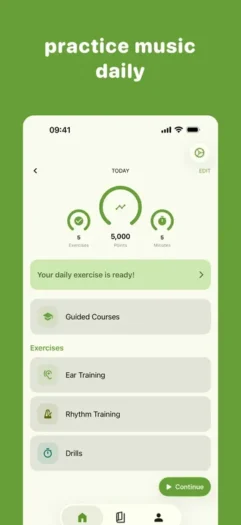
Perfect Ear is a comprehensive Music Theory and Ear Training app you can use in plenty of ways.
Perfect Ear is available on Android and iOS. It is free to start, with additional content and features unlocked through in-app purchases. Start with the included exercises before deciding whether the extra material suits your practice.
Perfect Ear is divided into three main sections: theory, ear training, and rhythm. It also has some bonus exercises to make you excel at specific music skills. The theory explanations help you understand the sounds and notation used in the drills.
The theory section provides the rudiments of intervals, scales, chords, modes, rhythm, and the circle of fifths. You can also access the theoretical explanation of each topic through ear training and the rhythm sections.
In the ear training section, you’ll be able to practice your aural skills through interval identification and comparison, interval singing, and interval sight-reading. You can also practice the identification of scales and chords.
In the rhythm section, you can familiarize yourself with rhythmical figures that get progressively more complex or practice how to keep the beat.
2. Piano Companion

This app, available for both iOS and Android, is particularly useful for piano students, but it can benefit anyone wanting to find out more about Music Theory.
Songtive’s Piano Companion is free to start, with PRO features available through in-app purchases. The available tools and unlocks differ between iOS and Android, so choose the edition for your device rather than assuming one purchase covers both.
Piano Companion features chords and scales dictionaries that can be very useful for reference at any time. It also explains the circle of fifths and chord pads to practice chord progressions.
Its virtual piano is useful for trying a chord progression as you learn the theory behind it. It is primarily a chord-and-scale reference and practice tool, rather than a complete ear-training course.
3. Tenuto
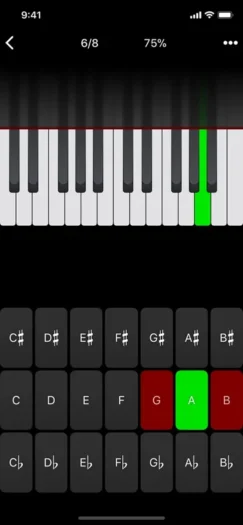
Tenuto 5 provides 24 customisable exercises and six calculators for iPhone and iPad, covering notation, instruments and ear training.
It is a paid app that works offline. Use the custom settings to concentrate on particular clefs, intervals or chords, and Challenge Mode to set a question or time limit. It is not available as an Android app.
Its twin app, Theory Lessons, provides interactive and animated Music Theory lessons that progressively become more advanced.
4. Music Theory Basics
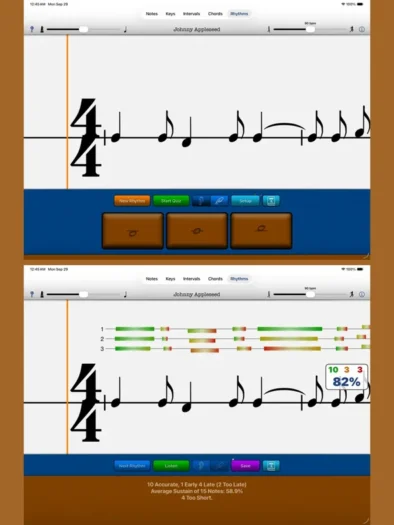
Music Theory Basics tests notation, piano-key recognition, key signatures, intervals, chords and rhythms on iPad.
Patrick Q. Kelly’s paid app is built around skills tests and a Grade Book for saved results, rather than a large course of animated lessons. Version 5 requires iPadOS 26 or later; it is not an iPhone or Android recommendation. Its ear-training mode can hide the keyboard or staff while you answer.
5. EarMaster
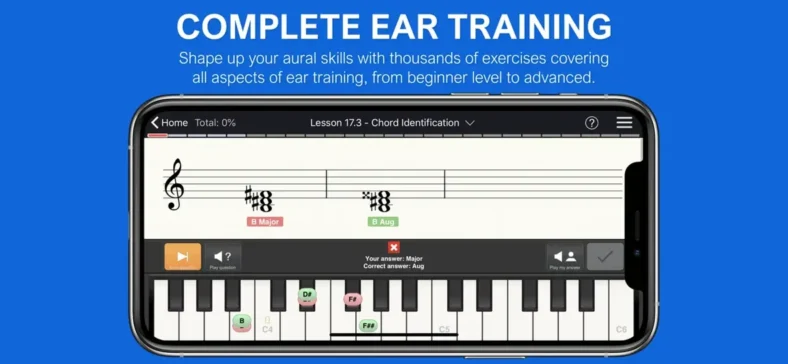
This app features exercises on interval identification and chord identification, all introduced by a theoretical explanation. It is also very useful to practice sight-singing.
EarMaster is available on iOS, Android, Windows and Mac. Selected content is free to try; the full set of lessons and courses requires the appropriate paid access.
EarMaster is particularly interesting because it supports the use of external microphones and MIDI controllers. You can plug in your favorite microphone to practice your sight-reading and have instant feedback on your results. Or you can plug in your MIDI keyboard to submit your answers to Music Theory exercises.
An individual subscription covers all supported platforms. A perpetual licence or in-app content purchase is tied to its specified platform and content, so it is not equivalent to an all-platform subscription.
6. Complete Ear Trainer
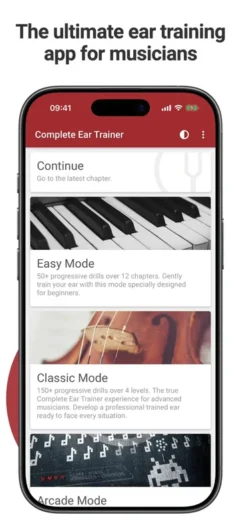
Complete Ear Trainer is an Android and iOS app for developing relative pitch through progressive listening drills.
The first chapter of each mode is free to try; a one-time in-app purchase unlocks the full version. Theory cards explain the concepts behind each chapter. Training relative pitch does not guarantee the development of absolute pitch.
You can use Complete Ear Trainer in three different modes: the Easy Mode, presenting more than fifty progressive drills over twelve different chapters; the Classic Mode, with more than 150 drills; and the Arcade Mode, a sort of challenge made of 21 drills.
You can also create Custom Training to suit your specific needs.
Each chapter, before the exercises, presents a sort of welcoming card with all the theoretical explanations you’ll need to undertake the challenge.
7. Music Theory Helper
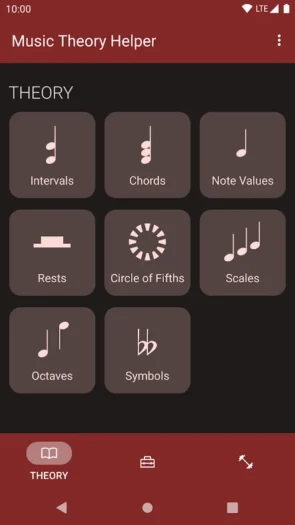
Music Theory Helper is an Android reference and practice app covering chords, intervals, scales, notation and the circle of fifths.
It includes listening exercises, note and interval reading, chord recognition and theory tools. The app is free with ads, but some features require an active subscription, including Practice Helper. It is useful when you want a reference and drills together rather than a single listening game.
8. Functional Ear Trainer
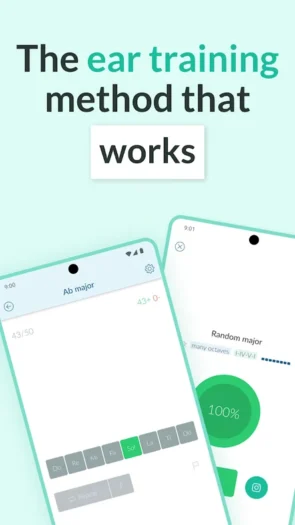
Functional Ear Trainer is an app for both Android and iOS, available for free but requiring in-app purchases, designed to enhance your aural skills.
Functional Ear Trainer uses Alain Benbassat’s approach to recognising notes within a musical key. After hearing the tonal context, you identify the function of a note rather than only measuring an isolated interval.
This makes it a useful companion to interval drills when your goal is to work out melodies by ear. The app is free to start with in-app purchases; regular practice can develop the skill, but no app can guarantee perfect hearing or a fixed result in ten minutes.
Practise with a small set of notes, then add more as recognition becomes reliable.
Use a trainer that matches the skill you need: tonal note recognition here, rhythm drills in Perfect Ear, or written theory in a reference app.
9. Theory Lessons
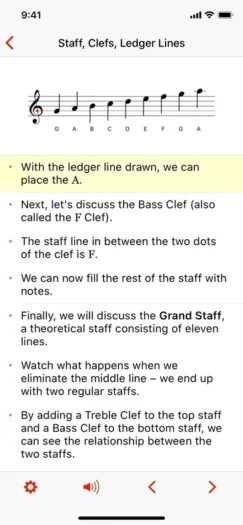
Theory Lessons provides 39 animated music-theory lessons for iPhone and iPad, covering notation, scales, intervals and chords.
This paid app focuses on explanations and animated examples, while its companion Tenuto focuses on exercises. Use it to learn or revisit note names, values, time signatures and harmony; choose Tenuto when you want repeated questions and progress reports. The lessons are also available on the developer’s website.
10. Music Tutor (Sight-Reading)
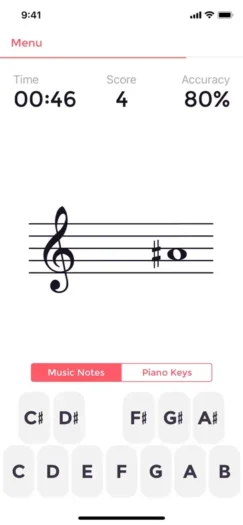
It can teach you how to decode standard musical notation and can also help you learn to read sheet music with an emphasis on sight-reading skills.
Music Tutor is a note-reading drill for Android, iPhone and iPad. Practise identifying notes in treble, bass or alto clef, choose a note range and review mistakes after a timed or untimed session. It trains recognition speed and accuracy rather than teaching every part of music theory.
The free version is supported by ads. An in-app purchase removes them; the separate Music Tutor Plus purchase is another paid route. Its focused format is useful when ledger lines or a less familiar clef are slowing down your reading.
Notable Mentions
Ear Gym (Android)
Ear Gym combines interval, chord, scale and rhythm exercises with reading and dictation practice. It is free to install with ads and in-app purchases. Custom exercise settings and guided practice make it useful when you want several training types in one Android app.
ET – Ear Trainer (Android, iOS)
Daniel Schenker’s paid ET – Ear Trainer combines listening questions with microphone-based exercises in which you sing or play back what you hear. It covers intervals, chords, scales and jazz-oriented harmony, making it a useful option for musicians who want active imitation as well as recognition.
musictheory.net (Website)
The developer behind Tenuto and Theory Lessons also offers free browser exercises and lessons. Use these for note reading, intervals, chords, scales and ear training when you want to practise without buying a mobile app. The mobile apps add their own touch-friendly presentation and offline access.
SoundGym (Website)
SoundGym focuses on production listening: frequency, EQ, compression, panning and space. It is a different job from learning intervals or reading notation. A basic account provides an entry point; Pro expands access to games, workouts and training tools.
teoria (Website)
teoria offers browser-based theory and listening exercises, including notation, intervals, scales, chords and dictation. Its free exercises are useful alongside a teacher or a written course when you want another way to practise a specific topic.
Summary
Choose an app around the skill you want to improve. Perfect Ear covers several areas, Tenuto is useful for custom offline drills, and EarMaster adds structured courses and singing practice. Piano Companion is better for exploring harmony, while Music Tutor concentrates on reading notes. Start with a small exercise set and increase the difficulty as your answers become consistent.