The 10 Best Bass Guitar Tuners (2026)

The development of cheap and good quality tuners has made it accessible for any bass guitarist to easily keep their instrument tuned. From cheap to premium options, from small clip-on tuners to tuner pedals, you will find everything you might need on this list.
My top pick is the Boss TU-3 Chromatic Tuner Pedal. This is one of the all-time greats of tuner pedals that allows for accurate tuning via a 21-segment LED Meter and drop tuning support.
My budget pick is the D’Addario Eclipse Headstock Tuner. It offers quick and accurate tuning, a full-color display, and a compact design that can be mounted in front of or behind the headstock.
For this article on ‘The 10 best bass guitar Tuners’, I evaluated each bass guitar tuner based on its accuracy, ease of use, design, durability, and affordability. I also made sure to include a variety of options, from basic tuners to more advanced models with additional features such as metronomes and tone generators.
I always bring my bass guitar tuner with me to rehearsals and gigs. It may seem like a small thing, but having a reliable tuner on hand can make a world of difference in a musician’s performance.
Contents
- The 10 Best Bass Guitar Tuners (2026) – At a Glance
- 1. Boss TU-3 Chromatic Tuner Pedal
- 2. D'Addario Eclipse Headstock Tuner
- 3. Roadie Bass
- 4. KLIQ UberTuner
- 5. Behringer TU300
- 6. Peterson StroboClip HD
- 7. Korg Pitchblack X
- 8. Donner DT-1 Chromatic Tuner Pedal
- 9. Polytune 3 Noir
- 10. Korg Pitchblack X Mini
- Key Features and Specs to Look For in a Bass Guitar Tuner
- Buyers Guide
- FAQs
- Conclusion
The 10 Best Bass Guitar Tuners (2026) – At a Glance

Now let’s move on to the full list:
1. Boss TU-3 Chromatic Tuner Pedal
The Boss TU-3 has a very successful history behind it left by its predecessor, the TU-2, and is one of the most-used and reliable guitar tuners out there. It works well with both guitars and bass with a stompbox design that looks amazing on any pedalboard.
Pros
- Accurate tuning
- Drop tuning support
- Sturdy construction for reliability
- Great visibility with High Brightness mode
- Supports both guitars and bass guitars
- Excellent value for money
Cons
- Lacks additional features
- No true bypass switching
This chromatic tuner features a 21-segment LED meter with brightness control and a High Brightness mode for those not-so-visible stage moments. Its Guitar Flat mode reaches six semitones down, while Bass Flat mode reaches three semitones below standard tuning.
For live performances, this pedal automatically mutes your instrument so there are no awkward moments on stage. Powered by a 9V DC power supply or one 9V battery, this tuner pedal supports 5 and 6-string bass guitars as well as 7-string guitars. Overall, it is a very popular and reliable choice for bassists.
Specs
- Type: Chromatic
- Format: Pedal
- Reference Pitch: 436-445 Hz
- Tuning Range: 16.3-4186 Hz
2. D'Addario Eclipse Headstock Tuner
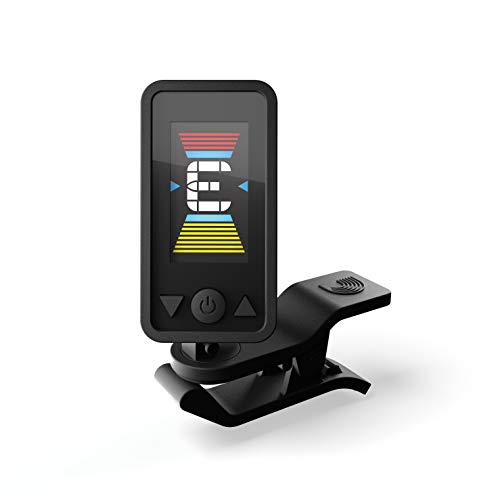
The D’Addario Eclipse Headstock Tuner is designed for quick and precise tuning during practice or on stage. It’s user-friendly and accurately tunes your instrument, ensuring you always have a reliable tuner at any given moment. The wide calibration range of 430-450 Hz provides many tuning options.
Pros
- Fast and accurate tuning
- Easy to use and read display
- Wide calibration range (430-450 Hz)
- Adjustable screen with limitless viewing angles
- Strong clamp that works on various headstocks
Cons
- Visually unappealing compared to other tuners
- The auto-shutoff feature can be annoying
- Not the most durable device
This headstock tuner is available in six trendy colors – black, blue, green, purple, red, and yellow which you can coordinate with your instrument or personality. However, it’s unfortunate that the Eclipse Guitar Tuner has some durability and fragility issues that could cause concerns in the long run.
Enjoy the convenience of a full-color vertical display, suitable for various lighting situations and angles. The Eclipse Guitar Tuner’s multi-swivel feature allows left or right-handed musicians to easily adjust the screen position to their liking, ensuring the best view during performances.
Specs
- Type: Chromatic
- Format: Clip-on
- Reference Pitch: 430-450 Hz
- Display Type: Full color

3. Roadie Bass
The Roadie Bass has a built-in vibration sensor for accurate tuning even in noisy places. Its precision works well for different instruments, letting you tune your bass guitar or other stringed instruments in about 30 seconds. However, it’s meant to be used only on bass guitars.
Pros
- Accurate tuner
- Easy to use and fast
- Capable of alternate/custom tunings
- Built-in vibration sensor for accurate tuning in noisy environments
- Powerful motor and long-lasting charge
- String winder feature for quick re-stringing
Cons
- May not work properly in very loud environments
- May accidentally unwind strings
- A bit pricey
Roadie Bass supports any music style with over 40 preset alternate tunings. It connects to the easy-to-use Roadie Tuner app, providing a smooth experience of discovering endless sound options. I enjoy how adaptable it is for any musician.
Ideal for busy musicians, the Roadie Bass has a long-lasting battery. Its sturdy Lithium Polymer battery keeps up with daily use for around a month on one charge. No need for multiple chargers, since it uses a USB-C cable for simple charging.
Specs
- Type: Chromatic
- Format: Clip-on Automatic
- Display: Bright LED (on the side)
- Battery Type: 1 Lithium Polymer
4. KLIQ UberTuner
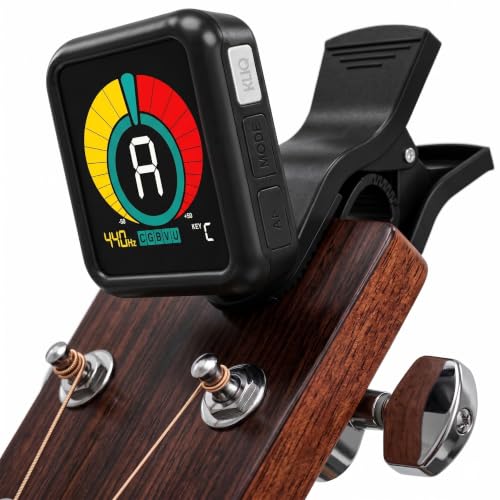
If you play different string instruments like acoustic guitars, violins, or ukuleles, this tuner has special modes for each one. Naturally, it works really well with bass guitars, you just attach it to the headstock and fire away.
Pros
- Easy, fast, and accurate tuning
- Suitable for various instruments
- Bright, high-contrast display, visible from any angle
- Durable, strong clip design
- Comes with a CR2032 battery
Cons
- Slightly larger than competitors
- The battery might drain quickly in some cases
- The on-off switch may be cumbersome for some
I liked the tuner’s bright, easy-to-read display which makes it user-friendly. It can adjust for flat/sharp notes. However, I don’t like the on-off switch because it’s difficult to use. Despite this flaw, the tuner’s performance and features still make it a useful tool for any musician.
The sensitive Piezo Sensor in this tuner helps provide quick and precise tuning. Instead of struggling with knobs and slides, this gadget’s technology guarantees perfect accuracy. That way, you spend less time getting ready and more time making music.
Specs
- Type: Chromatic
- Format: Clip-on
- Reference Pitch: 430-450 Hz
- Display Type: Full color
5. Behringer TU300
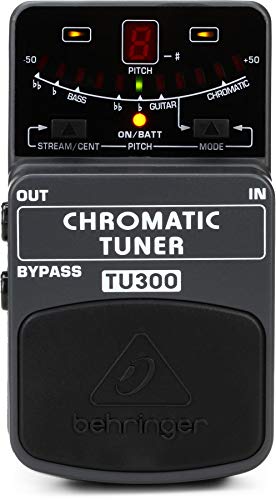
The Behringer TU300 features seven different modes, such as Standard, Flat, Double Flat, and Chromatic, catering to various music preferences and styles. If you enjoy standard, detuned, or tailor-made tunings, this device is incredibly adaptable and easy to use. I personally appreciate its affordable and accurate tuning capabilities.
Pros
- Great tuner at an affordable price
- Multiple tuning modes
- Precise 7-segment LED and 11-point Stream Meter
- Mute/bypass function for silent tuning
- Suitable for both guitar and bass
- Easy to use and read
Cons
- Plastic housing less durable than metal alternatives
- Takes a few seconds to respond when activated
- Battery compartment difficult to access
This tuner doesn’t only offer style and functionality; it excels in accuracy as well. The advanced 7-segment LED display and 11-point Stream Meter make tuning your instrument simple. Additionally, customizing your reference tone from 438 Hz to 447 Hz allows your sound to stay unique and harmonious with your preferences.
Don’t let poor lighting affect your performances anymore. This tuner’s illuminated display helps with accurate tuning even in the darkest parts of the stage. Its strong build and modern gray appearance make it an appealing addition to your equipment, while the small size and lightweight design won’t burden you during performances.
Specs
- Type: Chromatic
- Format: Pedal
- Display Type: LED
- Reference Pitch: 438-447 Hz

6. Peterson StroboClip HD
If you want an extremely accurate tuner, this clip-on one has 0.1 cents of True Strobe precision, making it perfect for tuning on the go! I love how precise it is. The easy-to-use screen quickly recognizes notes and shows pitch deviation.
Pros
- Highly accurate tuning (1/10th cent accuracy)
- Large, high-definition backlit display
- Over 50 exclusive, preset Sweetened Tunings
- Improved clamp width for a wide variety of headstock widths
- Easy to read in various lighting conditions
- Firmware can be updated
Cons
- Slightly more difficult to use than simpler tuners
- Short battery life
- Fragile construction
The Peterson StroboClip HD has over 50 pre-set Sweetened Tunings for many string instruments like guitar, bass, ukulele, banjo, mandolin, and violin. Its advanced technology is great for people who want accurate, instrument-specific tunings. However, it can take some time and patience to learn how to use it.
The rubber-coated jaws and adjustable rubber-cushioned clamp allow the tuner to securely fit different headstock widths without damaging your instrument. You can focus on your playing without any worries.
Specs
- Type: Chromatic
- Format: Clip-on
- Reference Pitch: 390-490 Hz
- Tuning Range: 16-1975 Hz

7. Korg Pitchblack X
The Korg Pitchblack X is my choice here for bassists who want a full-size display and the option of running a tuner from a 9V battery. Four meter modes let you choose a conventional display or a moving strobe; the stated strobe accuracy is ±0.1 cent.
Its selectable true bypass and ULTRA BUFFER make it easier to fit into different boards. Choose the buffer when a long cable run calls for it, or true bypass when another pedal already handles that job. The tuner mutes the output while you tune.
The full-size X earns this place over its mini sibling because battery operation is useful for a simple rehearsal rig. It takes more board space, and a power adapter is a separate purchase.
Pros
- Four display modes and bright display option
- Selectable true bypass or buffer
- 9V battery or DC supply
Cons
- Larger than a mini tuner
- Power supply sold separately
Specifications: Chromatic pedal tuner; ±0.1-cent strobe accuracy; E0–C8 range; 436–445 Hz reference pitch; 9V battery or 9V DC.
8. Donner DT-1 Chromatic Tuner Pedal
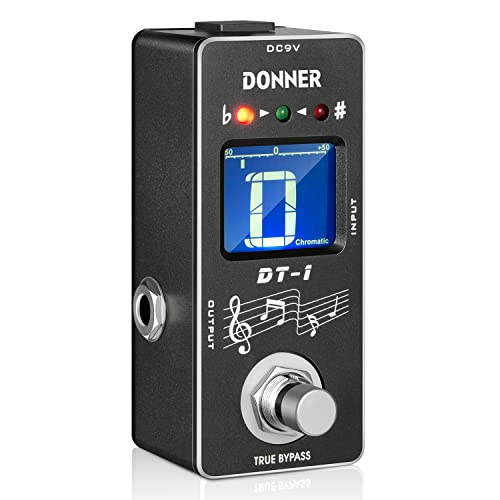
Tuning accurately is crucial, and this chromatic tuner pedal does just that. Its advanced strobe mode allows quick and precise tuning within +/- 1 cent for a perfect performance. The wide tuning range from A0 (27.5Hz) to C8 (4186 Hz) works with many instruments, making it an essential tool for any musician.
Pros
- Solid build and durable
- Compact size fits easily on pedal boards
- Wide tuning range (A0 to C8)
- Fast and accurate tuning
- Mute and bypass modes for convenient use onstage
- Easy-to-read LED display, suitable for outdoor performances
Cons
- Requires a separate power adapter, not included
- May produce a loud pop/click sound when switching on/off
- No battery compartment
One of the best features of this tuner pedal is its easy-to-see display. Bright LED lights and an LCD display offer quick and clear feedback, even in dim lighting. This makes it great for stage tuning during live shows and poorly lit practice spaces.
The Donner DT-1 eliminates noisy interruptions during tuning. Its excellent true bypass quality and twin channel feature lets you adjust your sound without adding any “pop” or “hum.” Plus, its strong construction ensures long-lasting use, making it a great partner for musicians in both studio and live performances.
Specs
- Type: Chromatic
- Format: Clip-On
- Display: Mini LCD
- Tuning Range: 27.5-4186 Hz

9. Polytune 3 Noir
If you’re a musician in need of quick, accurate tuning in a small package, this is perfect for you. The slim Polytune 3 Noir fits a small pedalboard; for bass, use its chromatic or strobe mode and tune one string at a time.
Pros
- Fast, accurate tuning
- Polyphonic, chromatic, and strobe tuning modes
- Built-in Bonafide Buffer for improved tone
- Compact size suitable for any pedalboard
- Bright LED display, easy to read
Cons
- Occasional difficulty picking up the low E string
- Doesn’t come with a power adapter
- Screen prone to scratches
I really like how versatile and precise this tuner is for different musicians. With polyphonic, chromatic, and strobe modes, it suits everyone’s preferences, and the strobe tuner even has ±0.02 cent precision for the best results. I also find the non-stop tuning mode helpful for onstage use, as it keeps you focused on your performance.
A great feature of this tuner is the built-in BONAFIDE BUFFER, which I think is important for keeping your sound clear across long cables and big pedal boards. With high-quality buffering, an amazing signal-to-noise ratio, and a true bypass option, your pedal board’s sound quality remains top-notch.
Specs
- Type: Polyphonic, Chromatic
- Format: Pedal
- Display Type: LED
- Accuracy: ±0.5 cent (chromatic), ±0.02 cent (strobe)

10. Korg Pitchblack X Mini
The Korg Pitchblack X Mini suits a crowded board where a dependable one-note-at-a-time tuner matters more than extra modes for strumming several strings. Its bright display and four meter options give you a useful choice between a familiar needle-style reading and finer strobe adjustment.
Korg specifies ±0.1-cent precision in strobe mode. The small enclosure includes its ULTRA BUFFER, but there is no battery compartment: plan a suitable 9V DC supply and a spare output on your pedalboard power unit.
This is the compact alternative to the full-size Pitchblack X above. Pick the larger model for battery operation; choose the Mini when saving space is the priority.
Pros
- Compact 45 mm-wide enclosure
- Four meter modes and bright setting
- Fine strobe tuning
Cons
- Requires an external 9V DC supply
- Small screen leaves less viewing area
Specifications: Chromatic pedal tuner; ±0.1-cent strobe accuracy; four display modes; 45 × 93 × 43 mm; 124 g; external power.
Key Features and Specs to Look For in a Bass Guitar Tuner
Accuracy, ease of use, display, durability, and price are all very important consideration points to keep an eye out for when choosing the right tuner for bass.
Tuning Accuracy
Tuning accuracy is of utmost importance when it comes to bass guitar tuners, as even the slightest deviation can significantly impact your overall sound. High-quality tuners like the Peterson StroboClip HD, with its True Strobe 0.1 Cent accuracy, set the standard for an unparalleled level of precision.
Similarly, the Korg Pitchblack X offers selectable buffered or true bypass to ensure precise tuning and sound quality, while the Polytune 3 Noir boasts an ultra-precise strobe tuner with ±0.02 cent accuracy, catering to musicians who demand the highest level of tuning precision from their gear.
Ease of Use
Ease of use is a significant factor when selecting the perfect bass guitar tuner for your needs, as it will undoubtedly have an impact on your tuning experience and your efficiency when setting up for a gig or practice session.
Some tuners are more user-friendly than others, with intuitive interfaces and simple operations. For example, the D’Addario Accessories Eclipse Tuner provides easy-to-read displays and multi-swivel action that allows you to set the ideal viewing angle while the KLIQ UberTuner offers dedicated tuning modes for different instruments.
Display Quality
Display quality is a crucial factor to consider while choosing the best bass guitar tuner, as it directly impacts the ease of use and tuning accuracy. A high-quality display should offer excellent visibility in various lighting conditions, including dimly lit stages and bright outdoor performances.
For instance, the KLIQ UberTuner boasts a bright, high-contrast display that’s easy to read from any angle, whereas the Peterson StroboClip HD features a high-definition, backlit display to display even the smallest pitch deviations.
Build Quality and Durability
Build quality and durability are crucial factors to consider when selecting the perfect bass guitar tuner for your needs. A tuner that is solidly constructed and designed to last will not only provide consistent performance over time but also withstand the rigors of daily use. High-quality tuners, like the KLIQ UberTuner and Peterson StroboClip HD, are known for their robust and reliable design, backed by comprehensive guarantees to put your mind at ease.
Price and Value for Money
When considering the price and value for money in bass guitar tuners, it’s essential to strike a balance between affordability and high-quality performance. Some affordable options like the D’Addario Accessories Eclipse Tuner provide excellent tuning capabilities without breaking the bank.
However, it’s also important to consider features such as extra tuning modes, display readability, and battery life, which may result in a higher price tag but offer additional value. For instance, the KLIQ UberTuner has a high-contrast display, making it an excellent investment for both beginners and professionals.
Buyers Guide
Types of Bass Guitar Tuners
Among the different types of bass guitar tuners, three common examples are electronic tuners, pedal tuners, and clip-on tuners.
- Electronic bass tuners: Devices like the Roadie Bass are standalone units that tune your bass guitar automatically. They come with both standard and custom tuning options, offering a simple and fast tuning process for your bass guitar.
- Pedal tuners: Pedal tuners, like the Behringer TU300, are great for on-stage bassists requiring quick and reliable tuning. These tuners can be integrated into your pedalboard setup, with built-in displays for easy readability.
- Clip-on tuners: Popular examples like the D’Addario Accessories Eclipse Tuner and KLIQ UberTuner easily clip onto your bass guitar’s headstock, providing fast and accurate tuning due to their highly sensitive piezo sensors.
Bass Tuner Frequency and Tuning Range
Understanding the importance of the Hz (hertz) frequency range is vital when choosing a tuner for bass guitars. A standard four-string bass has open notes from roughly 41 to 98 Hz; a five-string low B reaches about 31 Hz, with an extensive tuning range catered to in some products like the chromatic tuning range available in the Korg Pitchblack X Mini.
Bass Guitar Tuning Pegs and Replacement Tuners
Upgrading or replacing your tuning pegs and tuners can improve your instrument’s performance and make tuning more accessible. Brands like Squier offer bass replacement tuners, while Hipshot and Gotoh have popular tuning peg options to enhance your bass guitar tuning experience.
Compatibility of Guitar Tuners with Bass Guitars
Many guitar tuners are compatible with bass guitars. However, always cross-check the tuner’s specifications to ensure that it can accommodate the Hz frequency range and accommodate specific requirements like polyphonic tuning for bass guitars.
FAQs
1. What types of bass guitar tuners are available?
Bass guitar tuners are available in three types – clip-on, pedal, and rack-mounted. Clip-on tuners are affordable, easy to use, accurate, and portable. Pedal tuners are ideal for professional musicians and can be used with multiple instruments. Rack-mounted tuners are useful for studios, but not practical for gigging.
2. How many tuning modes do bass guitar tuners have?
Bass guitar tuners have several tuning modes, including chromatic, guitar, bass, and drop tuning. Chromatic tuners are more versatile and can tune for any instrument, whereas dedicated modes are easier to use and more accurate for specific instruments.
3. What is the accuracy of bass guitar tuners?
The accuracy of bass guitar tuners varies between brands and types, with some offering accuracy to within 0.1 cents. Generally, the more pricey the tuner, the more accurate it will be.
4. Can I use my bass guitar tuner on other instruments?
Yes, many bass guitar tuners have a chromatic mode that can be used on other instruments, such as guitars and violins.
5. Do bass guitar tuners need batteries?
Power requirements vary. Clip-on tuners often use coin cells, while some pedals accept a 9V battery and others require an external DC supply. Roadie Bass has a rechargeable battery. Check the exact model before buying a power supply.
Conclusion
Tuning is paramount to a good performance and having a reliable and accurate tuner can make all the difference in the world. Luckily, the market is filled with good options ranging from clip-on tuners to tuner pedals. Naturally, check your budget and consider your options wisely.
My top recommended tuner is the Boss TU-3 Chromatic Tuner Pedal. This is one of the all-time best tuner pedals that allows for accurate tuning via a 21-segment LED Meter and drop tuning support.
My second recommended tuner is the D’Addario Eclipse Headstock Tuner. This tuner offers quick and accurate tuning, a full-color display, and a compact design that can be mounted in front of or behind the headstock.