The 7 Best Bass Amps for Gigging (2026)

Whether you’re just starting out or performing at a large club, a good bass amp needs enough clean output for your band and stage. Small gigs may need only a modest combo, while louder bands need more headroom or support from the PA. Check whether a quoted power rating needs an extension cabinet.
Bass is one of the most sought-after sounds in the music industry. Nothing comes close to how bass sounds feel going through your body and making your heart beat faster. To truly hit those low-frequency sounds when gigging, you need a capable bass amp that has enough power to deliver them.
My top recommended gigging bass cabinet is the Markbass Standard 104HF. This front-ported 4×10 suits players building a separate head-and-cab rig. Choose a compatible bass head rated to drive its 4-ohm load.
My second recommended gigging bass amp is the Fender Rumble 500. This is a budget-friendly option that packs power and is great for small and large gigs.
Contents
- The 7 Best Bass Amps for Gigging (2026)
- 1. Markbass Standard 104HF 4-ohm Bass Speaker Cabinet
- 2. Fender Rumble 500 2x10" 500-watt Bass Combo Amp
- 3. Ampeg SVT-212AV 2x12" 600-watt Bass Cabinet
- 4. Gallien-Krueger MB212-II 2x12" 500-watt Bass Combo Amp
- 5. Hartke KB15 Kickback 1x15" 500-watt Bass Combo Amp
- 6. Fender Rumble Stage 2x10" 800-watt Bass Combo Amp
- 7. Orange Crush Bass 100 1x15" 100-watt Bass Combo Amp
- What to Keep in Mind When Buying
- Direct Input (di box) as an Alternative to Bass Amps
- Bass Amp Guide for Small vs. Big Gigs
- Verdict
The 7 Best Bass Amps for Gigging (2026)


Let’s compare them in more detail:
1. Markbass Standard 104HF 4-ohm Bass Speaker Cabinet
The Markbass Standard 104HF is one of the best all-around bass speaker cabinets for players who already have a suitable amp head. This is the 4-ohm version: its 800-watt figure is power handling, not built-in amplification. It is a great choice for those who want a versatile front-ported cabinet and have room to transport a 4×10.
Pros
- Excellent build quality
- Lightweight
- Great sound quality
Cons
- Styling may not appeal to everyone
- No castor wheels
The Markbass Standard uses a sturdy multi-ply cabinet, with a grille and protective corners to protect the speakers during transport. Its front ports let you position the cabinet without leaving clearance for rear-facing ports.
Four 10-inch neodymium speakers keep the weight down compared with many conventional 4×10 cabinets. A 1-inch compression driver and horn add high-end definition. It is still a substantial cabinet, so check the dimensions and lifting weight before choosing it for regular gigs.
Internally, the Markbass Standard’s components are sealed, glued, and screwed using high-quality components to ensure a consistent sound quality no matter how hard or frequently you play it.
2. Fender Rumble 500 2x10" 500-watt Bass Combo Amp
The Fender Rumble 500 is one of the most affordable bass amps out there, and the good news is that it’s not that far away from the high-end ones.
Pros
- Low price tag
- 4-band EQ and 3-button voicing palette for sound shaping
- Optional overdrive footswitch
- Gain and blend overdrive controls
- Has an AUX jack
Cons
- Unmarked knobs make precise adjustments challenging
- Cooling fan can be loud
The Rumble delivers 350 watts through its internal speakers, or 500 watts with a suitable extension cabinet connected. Its 4-band EQ and 3-button voicing palette give you useful control over the sound without a complicated menu.
The overdrive section has drive and level controls to adjust the distortion and its output. An optional footswitch lets you switch the overdrive on when you need it.
Featuring a pair of 10” speakers, the Fender Rumble’s bass output is out of this world. The icing on top is the AUX jack that allows you to plug in your smartphone, music player, or drum machine to practice.
3. Ampeg SVT-212AV 2x12" 600-watt Bass Cabinet
Following in the footsteps of the original SVT, the Ampeg SVT-212AV is a 600-watt, 4-ohm bass speaker cabinet. It needs a separate compatible amplifier head and pairs two 12-inch speakers with a compression driver for a classic Ampeg rig.
Pros
- True Ampeg tone
- Side handles for transport
- 600-watt power handling
- Top-notch poplar-ply construction
- Great speaker efficiency
Cons
- Can be too large for small gigs
The SVT-212AV is a more manageable alternative to an 8×10 for players who want a separate Ampeg head and cabinet. Its ported enclosure and adjustable high-frequency driver offer more control over the top end than a sealed, tweeter-free cabinet.
The Ampeg SVT-212AV has rugged poplar-ply construction and side handles for moving it between gigs. At 66 lb, it is a serious lift, so allow for that if you carry your gear alone.
If you want an Ampeg cabinet for small or medium gigs, the SVT-212AV is worth considering. Budget for a compatible head as well, and check that it can drive a 4-ohm cabinet.
4. Gallien-Krueger MB212-II 2x12" 500-watt Bass Combo Amp
The Gallien-Krueger MB212-II bass combo amp features ultra-efficient digital power plants, making it super lightweight at just 37 lbs. It’s capable of delivering 500 watts of power without affecting its amplification capabilities.
Pros
- Slim and lightweight
- 4-band EQ with gain control
- Chain Out for volume boost
- 12” speakers
- AUX jack
Cons
- May underperform in large gigs
- No mute switch
This combo bass amp also comes with a Chain Out that enables you to hook up an MBP-powered enclosure for large venues. And with the 4-band active EQ and gain control, shaping your sounds can’t be any easier.
The G-K MB212-II comes with two 12-inch neodymium speakers. Its headphone output is for quiet listening; connect your music player to the separate AUX input when practicing along with tracks.
5. Hartke KB15 Kickback 1x15" 500-watt Bass Combo Amp
The Hartke KB15 Kickback bass combo allows you to hear your tones while performing live because it can rock back 45 degrees. This enables you to pick up the sounds for accurate midrange and high-end feedback.
Pros
- 45-degree rock back for on-stage performances
- Silent headphone-out for practicing
- 100-900Hz one-touch boost
- 3-band EQ
Cons
- Limited EQ settings
The KB15 is rated at 500 watts peak and 250 watts RMS; compare the RMS figure when judging it against other amps. Integrating a 15” HyDrive paper-aluminum speaker, the KB15 delivers a high volume that’s suitable for live performances. Thanks to the silent headphones out, practicing with the Hartke KB15 can be a delightful experience.
Another good feature is the 100-900Hz one-touch boost that’s made possible by the amp’s shape control and 3-band EQ. This can be pretty handy when you need a low-mid bump or a bass spike without messing up the entire EQ settings.
The Hartke KB15 plywood cabinet is lightweight and sturdy, making it a good choice for traveling bassists.
6. Fender Rumble Stage 2x10" 800-watt Bass Combo Amp
The Fender Rumble Stage 800 integrates pro onboard modeling similar to that found in Fender’s higher-end line of Mustang GT amps. This means that the Rumble Stage is capable of delivering classic amp and cabinet tones. From stadium sounds to 50s bassman tones, the possibilities are endless. You can explore as much as you want with the variety of amp and cabinet models you get.
Pros
- Excellent onboard modeling
- 400 watts internal, up to 800 with an extension cabinet
- On/off compression tweeter
- 60-second looper for practice
Cons
- Plain aesthetics
- Bluetooth connection can be unstable
The Fender Rumble Stage 800 delivers 400 watts through its internal speakers, rising to 800 watts with a suitable extension cabinet. Its two 10-inch speakers and switchable compression tweeter make it a flexible stage combo, with an XLR connection for PA support at larger gigs.
To make things even sweeter, the Rumble Stage encompasses a wide array of features to complement its classic tones, including EQ and compression effects, octaves, reverbs, and delays. It also has a 60-second looper that can be quite handy when practicing or writing songs.
It’s also worth noting that this amp supports Wi-Fi and USB. Bluetooth audio streaming is a welcomed addition, too.
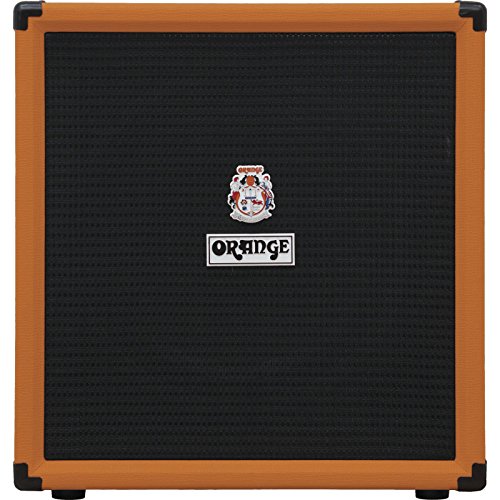
7. Orange Crush Bass 100 1x15" 100-watt Bass Combo Amp
The Orange Crush Bass 100 is a useful bass combo for home practice, studios, and small stages. Its 100-watt output suits quieter gigs or use with PA support. It shares the gain-and-blend approach of the larger Orange OB1, but at around 53 lb it is not an especially light carry.
Pros
- Compact design
- Good for silent practicing
- Balanced XLR output
- Optional overdrive footswitch
Cons
- Not suitable for medium or large gigs
It features a 6dB pad, an active EQ with parametric mid-control, and gain and blend controls in the overdrive section. It also has an effects loop for integrating FX processors and a footswitch for easily getting into overdrive mode.
The all-analog circuitry provides you with the exact same warmth that pro bassists love and use. Moreover, the XLR output is balanced and not overwhelming.
On top of that, the Orange Crush Bass has a single 15” speaker capable of delivering genuine bass tones. You also get an authentic-sounding CabSim headphone output that makes true silent practicing a possibility.
What to Keep in Mind When Buying
There are various factors that you need to take into consideration when shopping for a new bass amp. The power rating is the first thing you should take note of. If you want something for practice or small gigs, you don’t need 500 watts.
For a loud band, leave enough clean headroom rather than choosing from the wattage number alone. Speaker sensitivity, cabinet design, stage volume, and whether the PA carries the bass all affect how much output you need.
You might also want to consider taking a look at the available options in your local music stores. This gives you the chance to try out the amp before buying it. Another thing to keep in mind is sound sculpting. Bass amps with 4-band EQs and overdrive controls give you much better control over your sounds.
Speaker configuration also affects portability and projection. A 2×10 or 2×12 combo is a practical starting point for many gigging bassists, but speaker diameter alone does not determine loudness or sound quality. Try the amp with your bass at a realistic band volume where possible.
Direct Input (di box) as an Alternative to Bass Amps
Some musicians use a Direct Input (DI) Box to send their bass to the PA instead of bringing a large amp. This can work at small or large gigs when the PA and stage monitoring can handle the bass. Check the venue setup first, especially if you rely on an amp to hear yourself on stage.
Bass Amp Guide for Small vs. Big Gigs
How Many Watts and Speaker Size for a Small Gig?
For a quiet small gig, a 100-150-watt combo may be enough. A louder drummer or a band without PA support may call for more clean headroom. A good 1×12, 1×15, or 2×10 can all work; choose by the output and sound you need rather than a fixed speaker-size rule.
How Many Watts and Speaker Size for a Big Gig?
For a big gig, first check whether the PA will carry the bass. If your backline must cover the room, you will need substantially more output and speaker capacity than for stage monitoring alone. An amp rated around 500-800 watts can offer useful headroom, but check its internal-speaker rating and extension-cabinet requirements.
Verdict
To recap, choosing the best bass amp for gigging primarily depends on your needs. Naturally, it is paramount that you do your research beforehand and decide which amp best suits your needs before you commit to a purchase.
My top cabinet pick is the Markbass Standard 104HF for a separate head-and-cab rig. This 4-ohm cabinet needs a compatible amplifier head; it does not amplify the bass by itself.
If you want a more affordable self-contained combo, the Fender Rumble 500 is a solid choice. It has a 4-band EQ, 350 watts through its internal speakers, and up to 500 watts with a suitable extension cabinet.