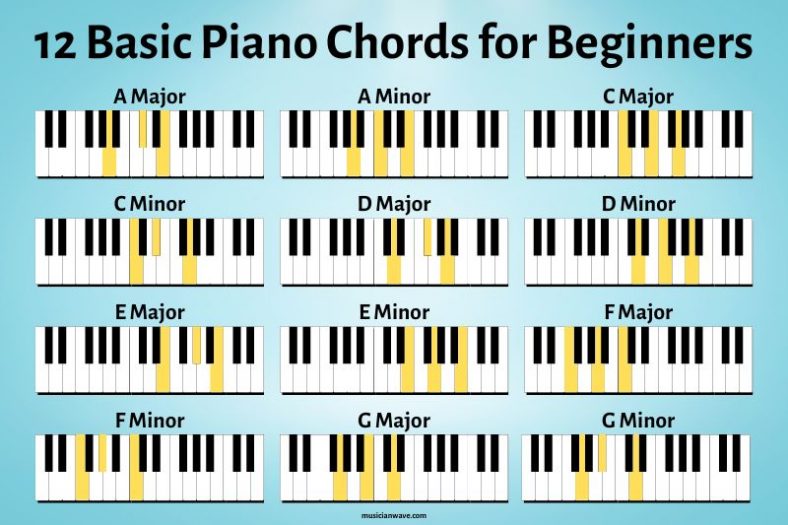
12 Basic Piano Chords for Beginners (With Chord Chart)
Chords are the foundation of learning any musical instrument. There are a lot of chords on the piano that you have to learn, but if you start with these basic chords and master them, you can start playing and learning a lot of popular songs.
To play a chord on the piano, you combine notes that sound together or are played as a broken chord. Every key on the piano is a note. The basic major and minor chords here consist of a root note, a third, and a fifth, and each chord takes its letter name from the root. That root stays the same even when another chord note is lowest.
The basic piano chords that you’ll learn in this article are three-note chords or triads. To master them, you need to learn how to position your fingers comfortably on the keys. For right-hand root-position triads, your thumb, middle finger, and pinky are a useful starting point. It might not be as comfortable at the beginning, but keep your hand relaxed and adjust the fingering for your hand size or the chord shape rather than forcing a stretch.
Contents
1. A Major (A)

The first chord is A Major. Major chords are often described as “happy” sounding, although the mood also depends on how they are played, and A Major is no different. It is also very close to A Minor, you just need to play one note differently, and that’s the C# instead of C. Also, it’s a very popular chord that you should learn when you’re starting.
2. A Minor (Am)

To play A Minor in root position with your right hand, play A (the root note) with your thumb, C with your middle finger, and E with your pinky. A Minor is a very popular chord, and it should be one of the first ones that you learn so you can start playing songs as soon as possible.
3. C Major (C)

C Major comprises the following three notes: C (the root note), E, and G. As you now know A, Am, and C, you should try going from one to another and practice your movement around the keys and listen to how that progression sounds.
4. C Minor (Cm)

C Minor is very similar to C Major, you just need to lower E to E-flat, the black key immediately to its left, while keeping C and G. By now, you should’ve picked up on the differences between the major and minor chords. To turn one of these major triads into a minor triad, lower its third by one semitone; do not add an extra note.
Now, you should play both the C Minor and C Major and hear the difference. You may hear why major chords are often called “happy” and minor chords “sad,” although tempo, rhythm, and the surrounding music can change that impression.
5. D Major (D)

D Major is comprised of the root note D, the major third note F#, and the perfect fifth A. When you learn D Major, you can play many different songs since it is one of the most commonly used chords in popular music.
6. D Minor (Dm)

By now, you should’ve figured out how to read the diagrams easily and maybe even guessed which note we need to move around to play D Minor. As you continue learning these basic piano chords, you will be more efficient at going from one chord to another, and it’s just a matter of time before you start playing songs!
7. E Major (E)

To play the E Major chord, you need to play the root note E, followed by the 3rd – G#, and the fifth – B. E Major, in its simplest form, is a very useful chord to have in your arsenal when you’re first beginning, and the same goes for E Minor, which is the next one on the list.
8. E Minor (Em)

E Minor is created when you play the root E, followed by the 3rd – G, and the fifth – B. Pretty similar to E Major, right? That’s because the only difference between the two is when you play E Minor, you play the 3rd note – G, instead of G#.
9. F Major (F)

F Major consists of three notes: F (the root note), A, and C. If you know all the notes that make up the chord, you can play these three notes anywhere on the piano and still get F Major. Although, you will usually play the F note as your lowest note on the piano.
10. F Minor (Fm)

The F Minor triad consists of the root note F, the third note – A-flat, and the perfect fifth – C. F Minor is a very interesting-sounding chord and gets even more interesting if you add chord inversions to it.
11. G Major (G)

To play the G Major chord on the piano, you need to play the following three notes: G (the root note), B (third), and D (fifth). Like some others on the list, G Major is a very used chord in popular music, and you need to know it before you start learning to play any songs.
12. G Minor (Gm)

Similar to G Major, G Minor, for its root note, has the G note, and the fifth note is also the same between the two, which is the D note. The only difference is that in order to play G Minor, you play the third B-flat instead of B. The complete G Minor chord is G, B-flat, and D.
What Are Chord Inversions?
Once you learn all of the basic piano chords, you can start playing around with chord inversions, where everything becomes more interesting. Chord inversion is simply moving around different notes on the piano to get different sounds from the same chord.
Just like any song has its arrangement, every chord also has its arrangement. For example, in its simplest form, the C Major chord has the notes C-E-G. This is also what it’s called the root position of the chord. The first inversion of C-E-G is when you play the C note on the top of the stack, making E-G-C. After that, move E up an octave to get G-C-E, the second inversion. The lowest note tells you the inversion, while C remains the root. It only becomes more interesting after that, so go ahead and have fun.
Every chord I covered in this article follows the same rules for chord inversion, so once you practice C Major, you know the rest of them.
Conclusion
It’s important to know the basic piano chords before you start playing different songs on the piano. Playing around with chord inversions can also get you on a fast track to learning this beautiful instrument. If it feels that it’s really hard to learn this stuff, you need to remember that learning any instrument is not a progressive line that goes from beginner to pro, it’s a curve with very sharp spikes, or rather times when things just click. And the most important thing is to have fun doing it.